Gridstream Meters
Meter Overview
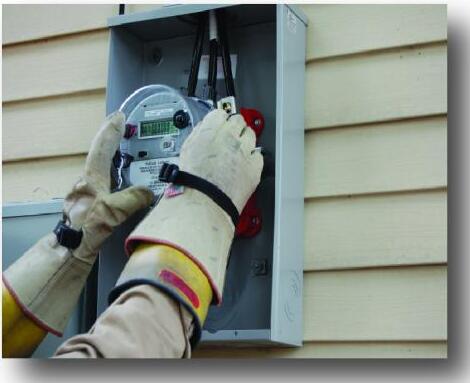
South Plains Electric Cooperative has chosen a proven system that offers many advantages, including remote disconnect/reconnect, better outage detection, “blink” troubleshooting, meter tampering detection and eventually the ability for members to remotely view and manage their usage details. The name of the system is Gridstream.
Main features of the system will be:
- Reduce the number of cooperative vehicles on the road, saving fuel and time.
- Detect and pinpoint electricity theft.
- Produce valuable data to help member services work with individual members to lower kWh consumption.
- Ensure efficient and effective investments in new power lines, substations, etc.
- Reduce line losses.
- Better data will help SPEC proactively prevent outages and monitor low voltage scenarios.
- Ability for queries will speed restoration.
- Member location transfers and connects/disconnects can be processed in real time.
- Are integrated with member service, billing, engineering, and outage computer systems.
- Communicate with substation equipment over the radio frequency network.
- Are secure.
- Provide greater privacy by eliminating most on-premises visits.
South Plains Electric is confident the new Gridstream meters are safe and will offer enormous benefits for both the members and the Cooperative. However, some members may still have concerns based on rumors or information in the media. Seemingly legitimate, but unscientific and unsupported, criticisms or claims have raised concerns about privacy and/or health. You can read more about how we are protecting our members here: Privacy & Health Concerns.
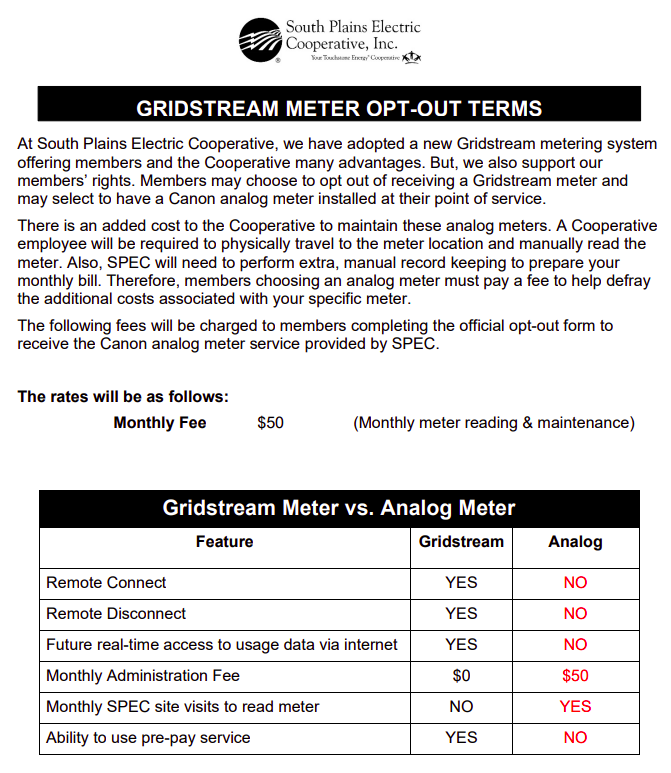
We do offer a meter option for members not wanting the new Gridstream meter installed. For more information, click here: Gridstream Meter Opt-Out Option.
Opt-Out Form
Privacy Information
Member’s kWh usage data will be collected and sent in small packets back to the Cooperative and stored within billing records. This encrypted information will be sent in many very small information packets throughout the day. It’s extremely unlikely, but not impossible, that someone could access that information, but it will only include metering data that is meaningful to the Cooperative. It will not include member’s personal data such as address, social security number, banking data, or any other identifying information.
The kWh usage information from our new Gridstream meters will only be used to help us serve our members better. We do not ever sell member information to any third party and we adhere to a strict privacy policy to protect our members. Additionally, the Gridstream meters will allow us to determine if someone tampers with your service.
As some detractors claim, there will be no way for the Cooperative or anyone to “see” or “hear” inside your home or business or to “detect” the types of appliances or equipment being used. All equipment will be mounted outside at the point of service and will not include cameras or any other devices to collect private data.
Health Concerns
Research conducted by the Federal Communications Commission (FCC), the Electric Power Research Institute, the Utilities Telecom Council, and others, has found no negative health impacts from digital meters that send information via a wireless communications network. The radio frequencies (RF) emitted by digital meters fall well below the maximum recommended in federal guidelines.
People are continuously exposed to very low levels of natural and man-made radio frequency fields, or RF. Even the earth’s surface and the human body are constant sources of RF fields. Digital meters send information about home electricity use by RF signals. Gridstream meters will emit RF similar to that of many common household devices such as baby monitors, cordless phones and remote-controlled toys and medical monitors. And in fact, cell phones and cordless phones emit much greater RF and people hold them up to their heads.
The exposure from your new meter is much lower than other common sources for two reasons: infrequent signal transmission and distance. On a daily basis, the Gridstram meters emit less than five minutes per day. In addition, these meters are outside a wall separating the meter from the living space. This combination of placement and infrequent operation means that you would need to be within one foot of 7,000 Gridstream meters all communicating at the same time to reach the FCC exposure limit.
Summary
SPEC is a not‐for‐profit, private business that is solely owned and operated by the members who receive our electric service. When our board of directors approves a policy or procedure for the use of new equipment and technologies, they do so knowing that it will also apply to their own homes and their own families. In using this type of metering system, we have not only deemed it to be a wise and safe choice for all Co‐op members and their families, but our own families as well.
Frequently Asked Questions About Our Gridstream Meters
South Plains Electric Cooperative is committed to protecting the privacy and security of our members’ personal information. The Co-op does not sell data to any third party, and never will. Our privacy policies can be found here.
Our new Gridstream meters will collect kWh usage and send it by secured and encrypted data packets back to our office. They will also send a signal if they are disconnected. That’s it. These meters cannot detect any activity inside the home. They cannot be queried to see what how a member is using the electricity. The Gridstream meters only “know” how many kWhs are being used and if the meter is “alive” and active.
Additionally, the data sent is only about kWh usage as detected by the meter. There is no account data such as name, address, credit information, or member number, sent in electronic form from the meter.
Gridstream meters actually afford members GREATER privacy than an analog meter, since a SPEC employee will not need to visit the site of the meter to read it.
It’s extremely unlikely, but not impossible, that someone could access information from the Gridstream metering system. The Gridstream meters allow us to determine if someone tampers with your meter, so we will be able to help protect you. Even if someone were to hack your meter, the “data” is useless to them since it will not include any personal information.
Data from the meters will be sent back to the Co-op office via radio frequency (RF). All humans are continuously exposed to very low levels of both natural and man‐made RF fields. Even the earth’s surface and the human body are constant sources of RF fields. Most humans interact daily with numerous items that emit RF fields: microwave ovens, cell phones, cordless phones, televisions, Wi‐Fi signals, computers, tablets, antennas and receivers, and even household lighting.
The small amount of RF emitted from the Gridstream meter, which resides outside and away from any direct human contact, is well below levels produced by the aforementioned common household devices that the Federal Communication Commission has deemed safe for operation. People press cordless and cell phones next to their own heads and constantly interact with electronic tablets and personal computers for hours.
The exposure from the Gridstream meters is much lower than other common sources for two reasons: the infrequent signal transmission and the distance from human interaction. On a daily basis, the Gridstream meters emit power for less than five minutes per day. In addition, these meters are typically placed outdoors, with a wall separating the meter from the living space.
Lastly, SPEC is operated by people who are also members and receive electric service from the Cooperative. Our board of directors, who approve policies, are also members receiving SPEC electricity. When the board members and Cooperative management approve new equipment and technologies, they do so knowing that they are selecting this choice for their own families.
In summary, research conducted by the Federal Communications Commission (FCC), the Electric Power Research Institute, the Utilities Telecom Council and others has found no negative health impacts from digital meters that send information via RF. Members can rest assured that the metering products SPEC selected underwent testing by an accredited lab to verify that they have met or exceed all FCC requirements for safety.
There have been some claims that digital meters are not as accurate as analog meters. The exact opposite is true. Our old analog meters calculate kWh used by measuring it. The new meters calculate kWH by counting it. That’s an important distinction. Counting offers an exact result instead of the approximate results from measuring. Therefore, digital data is more accurate.
The Gridstream meters we are using follow all performance standards set by the American National Standards Institute. Lastly, our meters are all rigorously tested before they leave the factory and tested again by SPEC employees before they are deployed to the field.
Power bill costs are cyclic, and the highs and lows of these bills generally depend greatly on the weather. On the billing cycle that follows the hottest and coldest months each year, the Co-op receives more high-bill complaints. These are due to increased kWh use, mostly likely by heating and air conditioning during extreme weather. It will be inevitable, over our five-year deployment, that we will change meters out during these months.
There is no extra charge for the new meter, thus, your meter change-out did not increase your bill.
A higher-than-normal bill is likely due to a weather-related event, or even an equipment failure at the residence or business. We absolutely invite and encourage any member that may have a high-bill concern to call us. We’ll schedule a meter test, free of charge.
We recognize that there will be members, for their own personal reasons, who will remain opposed to the Gridstream meter. To accommodate these members, we’ve developed an opt-out structure for them.
For members opting out of receiving a Gridstream meter, there will be a monthly fee of $50 for several reasons: 1) Members opting out will require an atypical analog meter outside of the regular inventory; 2) A Co-op employee will be required to physically travel to the meter location once a month and take a manual reading; 3) There will be additional administration costs to the Co-op to manually calculate and bill opt-out accounts; 4) Because we are a member-based, not-for-profit organization, extra costs are spread across the entire membership. We cannot make other members pay for the additional costs of service to individuals that choose an atypical meter.
For members wishing to opt out, they may order this special service by calling member services, or online here.